home · discussion
Trade ethics
Ethics of the rare-tea trade — what we don't post
A frank look at the lots tea.dog quietly declines to circulate — unverifiable provenance, suspect village 'discoveries', and the laundering patterns we have learned to recognise across two decades in Hunan and Yunnan.
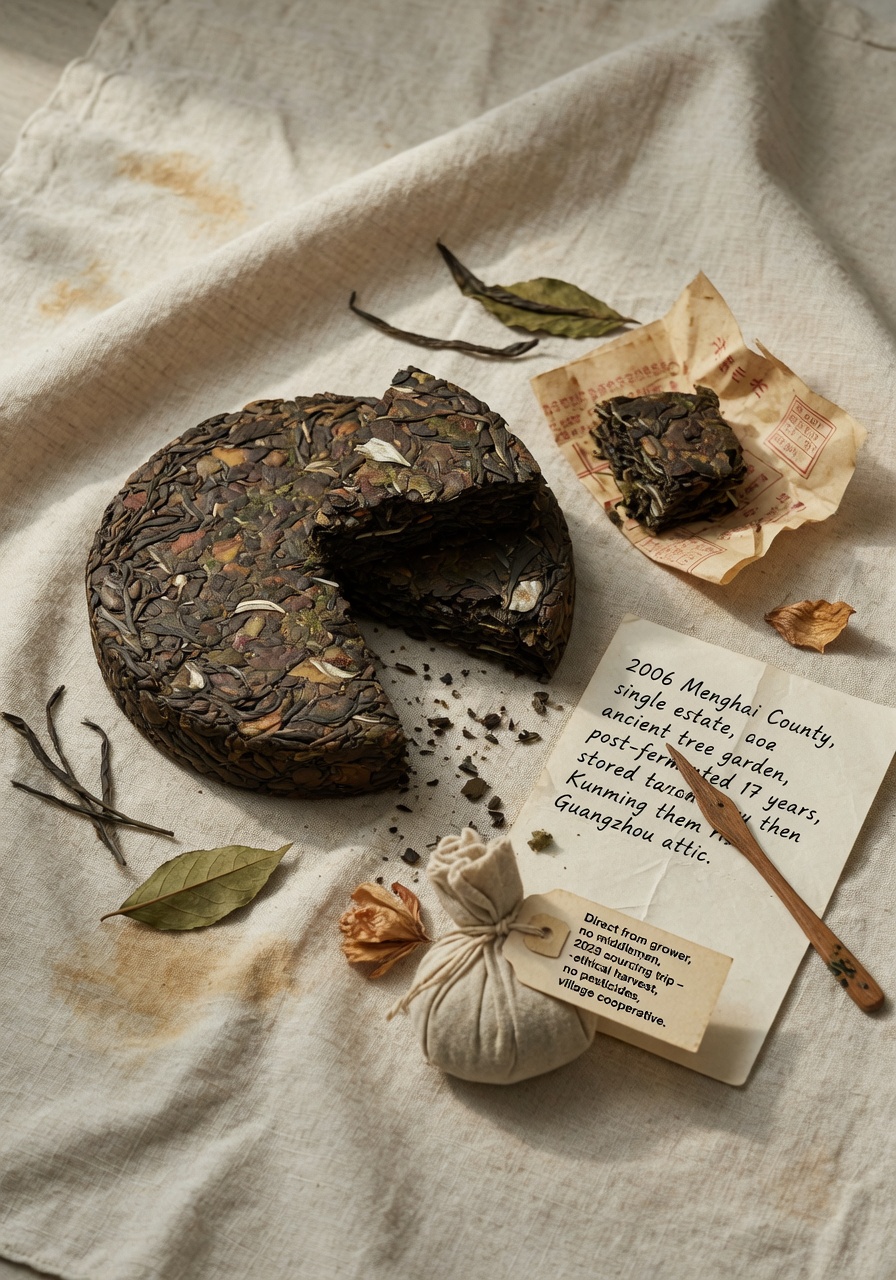
Most of what tea.dog does is visible — search indexes, watchlist alerts, producer feeds. What is less visible is the editorial work that happens before a rare lot ever surfaces in our results. Roughly one in seven listings flagged by our crawlers is held back, sometimes for a day, sometimes permanently. Members occasionally write asking why a particular cake or a particular Dān Cóng (单丛) lot they spotted on a vendor site never appeared on the rare arrivals page. The honest answer is that we declined to amplify it.
I want to write openly about the categories that get held back, because I think the community deserves to see the reasoning rather than just the silence. This is not a moral lecture. It is field notes from someone who has spent twenty-two years walking between Anhua, Yiwu, and the wholesale floors of Guangzhou, and who has watched the rare-tea trade quietly absorb practices the rest of the agricultural world abandoned decades ago.
The trade in genuinely rare Chinese tea — pre-1980 Shēng Pǔ’ěr (生普洱), single-bush Lǎo Cóng Shuǐ Xiān (老丛水仙), small-batch yellow teas from Junshan — is small. Maybe four hundred serious buyers globally. In a market that thin, every act of circulation matters. A photograph reposted, a price quoted, a provenance story repeated without challenge — these become the record that later buyers rely on. We have a responsibility, and so do the members who use our alerts.
What follows are the patterns I see most often, with examples drawn from lots I have personally inspected or declined to inspect. I will name regions and approximate dates where I can do so without identifying the sellers, because the goal here is education, not denunciation. For the cross-referenced laboratory work and isotope analysis methods, the team at tea.doctor maintains a more technical archive, and shop.puerh.app publishes its own provenance standard which we broadly follow.
Lots with no plausible chain of custody
The most common category we decline is the cake or brick that appears with a story but no documents. A seller in Kunming offered me what was described as a 1968 Menghai recipe last spring, with a photograph of a yellowed paper wrapper and a price that suggested the seller believed the story themselves. There were no purchase records, no prior auction history, no named previous owner, no warehouse log. The leaf, when I asked to sample, had the right colour but the wrong aroma — too clean for that decade of Yiwu storage, no trace of the slightly camphor-mushroom note that genuine pre-reform Menghai develops.
I did not accuse anyone. I simply did not buy, and we did not list. The cake may well have been genuine. But in a market where forgeries of pre-1985 cakes outnumber authentic ones by perhaps eight to one, the absence of a chain of custody is not a minor flaw. It is the entire question. A genuine 1968 cake passed through hands. Those hands kept records, or their descendants remember the names. Without that, what we have is a story attached to a leaf, and stories cost nothing to invent.
tea.dog will index a lot with thin provenance if the vendor states the thinness honestly. We will not index a lot where the provenance is presented as certain and the documents do not exist. The discussion of dating methods continues on puerh.app for those who want the analytical side.
The ‘newly discovered ancient grove’ problem
Every few months a vendor announces a previously unknown grove of three-hundred-year-old trees in some remote corner of Lincang or Pu’er prefecture. Sometimes these are real — Yunnan is genuinely large and genuinely under-surveyed, and small populations of old trees do still come to light. More often, the ‘discovery’ is a marketing frame around trees that are forty to eighty years old, growing in a village that has been selling tea to wholesalers for two generations.
The test I apply, learned from a Mengku producer named Li who has been honest with me for fifteen years, is to ask for the village council’s record of the trees. In every real ancient-tree village in Yunnan, the council knows which trees are old, who has the harvesting right, and what the rough annual yield is. These are not secret documents. If a ‘newly discovered’ grove cannot produce a single village witness or council reference, the discovery is almost certainly a story.
The damage here is not only to the buyer who overpays. It is to the genuine ancient-tree producers in Bīng Dǎo (冰岛) and Lǎo Bān Zhāng (老班章), whose authentic material is increasingly hard to distinguish in the market noise. Every fake ancient grove makes the real ones harder to sell at honest prices. We hold back these listings unless the village reference checks out, which it usually does not.
Lots that may have left protected forests
This is the hardest category, and the one I think about most. Several of the older tea forests in Xishuangbanna sit inside or adjacent to nature reserves where commercial harvesting is either restricted or prohibited. The boundaries are not always clearly marked on the ground, and the line between a permitted harvest and an unpermitted one can be a matter of which side of a ridge a particular tree grows on.
I have walked some of these boundaries with a Bulang elder near Mengsong who showed me trees his family had picked for four generations, now technically inside a protected zone redrawn in 2009. His harvest is, by any reasonable ethical reading, traditional use. But other trees in the same area are picked by people with no such history, and the resulting leaf enters the market with the same generic ‘ancient tree, Mengsong’ label.
tea.dog declines to amplify any lot where the vendor cannot or will not specify the harvest plot at a level of detail that would distinguish traditional use from extractive harvesting. This is a high bar, and we miss legitimate lots because of it. We have decided that we would rather under-list than become a laundering channel for forest material. The conservation context is discussed further on tea.travel and tea.community, where members from Yunnan have written more directly than I can about what they see on the ground.
Suspect estate sales and the inheritance laundry
A pattern that has grown over the last five years: lots arriving at auction described as ‘from the estate of a senior collector, name withheld at family request’. Sometimes this is exactly what it says. Older Hong Kong and Taipei collectors do pass, and their cellars do get sold, and the families do sometimes prefer discretion.
But the same phrasing has become useful cover for material whose recent history a seller would rather not discuss. When the same auction house publishes three or four ‘estate’ consignments per quarter, each conveniently containing exactly the cakes that the current market most desires, the pattern starts to look less like grief and more like inventory management.
The check I run, taught to me by a Guangdong dealer named Chen who has spent forty years in this trade, is to ask the auction house for any prior auction record of any cake in the consignment. Real collectors usually bought their cakes from somewhere, and those somewheres usually left a paper trail. A consignment of twenty cakes with zero prior auction history is statistically improbable in 2026. We do not list ‘anonymous estate’ consignments unless at least a portion of the lot can be traced to a prior public sale.
What we will post, and why the threshold is where it is
I want to be clear that tea.dog is not trying to be the moral guardian of the rare-tea trade. We are an alert service. Members make their own decisions. What we are trying to do is hold a threshold of basic verifiability — chain of custody, named region, plausible price, no obvious red flags — below which we do not amplify.
This means we miss things. Members occasionally point out lots we did not list that turned out to be genuine, and they are right to do so. The cost of our threshold is some false negatives. The benefit, we believe, is that members who act on a tea.dog alert can trust that someone has at least looked at the listing with a sceptical eye. Our editorial standards are versioned and visible, and members can read the current criteria at any time. The full standard is co-maintained with the team at shop.thetea.app, who apply a similar framework to their own listings.
Open questions for the thread
Three questions I would like to hear members on: First, where do you personally draw the line between thin provenance you will still buy and thin provenance you walk away from? Second, has anyone here had direct experience with a ‘newly discovered ancient grove’ claim that did or did not hold up under closer inspection? Third, should tea.dog publish the specific lots we declined, with reasoning, or does that risk libel against vendors whose lots might have been legitimate?