home · discussion
Watchlist craft
How the alert system actually works
A working note on what tea.dog's alerts actually catch, what they miss, and how to tune a watchlist so the signal you receive is the one you would have chased on foot anyway.
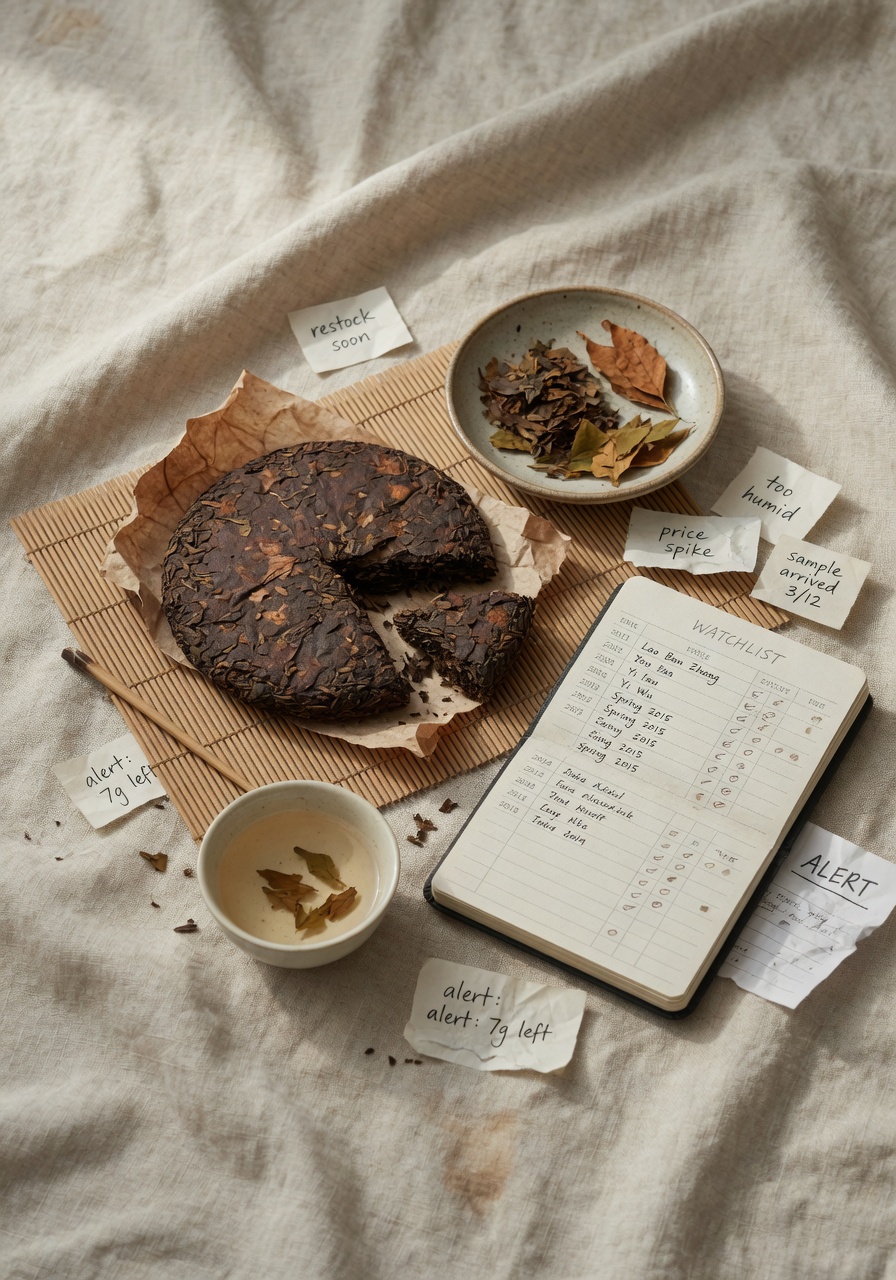
Most members arrive at tea.dog with the same assumption — that an alert system is a kind of bell that rings when a rare cake appears anywhere in the network. That description is half true and half misleading, and the half that is misleading is the half that produces frustration. An alert is not a bell. It is a filter you build, gradually, against a stream of vendor uploads, auction listings, and producer notifications that, in raw form, is already too noisy to read.
I want to set down what I have learned watching the feed across the past eighteen months, mostly from the Russia–Mongolia corridor where I spend my working life — Kyakhta, Ulan-Ude, the small import desks in Saint Petersburg — but also from the wider catalogue that flows through shop.puerh.app and shop.thetea.app. The honest summary is that the alert system works exactly as well as the watchlist behind it, and a watchlist built in ten minutes will deliver ten minutes of value.
A real find — a 2004 Shēng Pǔ’ěr (生普洱) cake from a known Yiwu pressing, a small batch of Wò Duī (渥堆) shou from a producer who normally never sells outside Kunming — these things do pass through the feed. I have caught three of them this year. But each catch was preceded by months of refining the filter, and each was framed by a dozen near-misses where the alert fired and the listing turned out to be either misattributed, overpriced, or already gone.
What follows is not a manual. It is a working note, the kind I would write for a younger colleague joining the desk. The community should add to it, argue with it, and correct the parts I have got wrong from my own bias toward dark and aged teas. Members working in green and yellow leaf — Zhou Xiang’s territory in Hunan, Chen Hui Yi’s white-tea coast in Guangdong — will see different patterns in their feeds, and those patterns deserve their own threads.
What the alert is actually watching
The alert system reads three streams. The first is vendor catalogue updates — every new SKU posted to shop.thetea.app, shop.puerh.app, and the partner vendors we index. The second is auction listings, which surface separately because their lifecycle is short and the price signal matters. The third, and the one most members underuse, is producer notification — direct feeds from roughly forty Chinese workshops who publish small-batch availability before it reaches retail.
When you add a term to your watchlist, the system does not search those three streams equally. Catalogue updates are checked on a six-hour cycle, auctions every twenty minutes, producer feeds at the moment the workshop publishes. So an alert tagged to a Yiwu producer in Xishuangbanna will reach you within minutes of the workshop posting, while the same cake appearing later on a third-party catalogue may take half a day to register. This is the first thing collectors miss — the producer feed is faster, and quieter, than the retail layer. If you only watch retail, you are reading yesterday’s news.
In my own watchlist I keep three distinct tiers: producers I trust by name, regions I trust by terroir, and styles I trust by process. The three tiers fire at different rates and demand different responses. Producer alerts I act on within the hour. Region alerts I read the same evening. Style alerts I review on Sunday with tea in hand.
Procurement leads versus auction tips
These are not the same instrument and should never be configured the same way. A procurement lead is a signal that a workshop has pressed something and is offering it — there is no competing bidder, the price is set, and the question is whether you want it. An auction tip is a signal that something is currently in price discovery, and the question is whether you want to enter that discovery and at what ceiling.
For procurement, the useful alert is broad and slow. I keep a standing alert on six Menghai-area workshops with no price filter at all, because the interesting listings from those producers are the ones I would never have predicted — a small reissue of a 2011 recipe, a Mí Lán Xiāng (蜜兰香) leaf finished in an unusual way. A narrow filter would have hidden these.
For auctions, the reverse. The auction feed on shop.puerh.app moves quickly and the noise is high — old cakes of uncertain provenance, repressed wrappers, mixed lots. Here I run tight filters: named producer, vintage band, minimum weight, maximum opening bid. Anything looser produces an inbox I cannot read. The auction-side material on puerh.app — the provenance notes and the wrapper-comparison archive — is what makes the tight filter survivable, because once the alert fires I can verify in the same evening rather than chasing the seller for documents.
The Kyakhta lesson — proximity changes the filter
I keep a desk in Kyakhta because it sits on the historic tea road and because Mongolian and Buryat buyers move through it with their own preferences and their own informants. What I learned in the first year working that desk was that proximity to a trade route reshapes which alerts matter.
A collector based in Western Europe should weight their alerts toward catalogue and auction signal, because their physical access to a workshop is zero and the retail layer is, for them, the real layer. A collector based in Buryatia or Mongolia, or anyone who travels into Yunnan twice a year, should weight toward producer feeds and quietly ignore most retail alerts — because by the time a cake reaches retail catalogue, the version they could have bought directly is already sold.
This is not theoretical. In April I had an alert fire on a small Bulang pressing through a retail vendor at a price I knew to be roughly 2.3× the workshop’s direct price two months earlier. The alert was accurate — the tea was real, the listing was honest — but the alert was useless to me, because the procurement window had closed in February. A collector with no field access would still have found the retail price reasonable. The same signal, two different answers. This is why the watchlist must be configured to your own logistics, not to a generic ideal. The notes on travel logistics at tea.travel are worth reading alongside this.
What counts as noise, and why noise matters
Members sometimes ask me to help them tighten a watchlist that is producing thirty alerts a day. My answer is usually that they should not tighten it yet — they should read the noise for two weeks first.
Noise is informative. The pattern of false positives tells you which terms in your watchlist are ambiguous, which vendors are aggressive in their tagging, and which categories of listing the system is currently overweighting. If you tighten too early you remove the ambiguity before you have learned from it, and your filter ends up shaped to your assumptions rather than to the actual shape of the market.
A worked example. A member running an alert on ‘Wò Duī shou, 2010 or earlier, Menghai’ was receiving roughly twenty hits a week, of which two were genuine. We did not tighten the filter. Instead, for fourteen days, the member logged why each false positive failed — wrong region, wrong vintage band, repressed wrapper, mis-tagged style. At the end of the fortnight the pattern was clear: 70% of the noise came from three specific vendors who tag aggressively. We then excluded those three vendors from that single alert, kept the rest of the filter wide, and the signal-to-noise ratio jumped without losing any catches. The vendors remain in other alerts where their tagging is more reliable.
A watchlist is a living document. Mine is on its fourth major revision this year.
How to set one up if you are starting today
If you are new to the system, here is what I would suggest, with the warning that it reflects my bias toward aged and dark teas.
First, pick three producers. Not regions, not styles — three specific workshops whose work you have already tasted and trusted. Add them with no price filter, no vintage filter, no weight filter. Let the producer alerts run wide for a month and read every one. This is your baseline.
Second, pick one region you are studying. For me when I began this was Yiwu, because I wanted to learn the village-level differences and the only way to learn them was to see enough listings to build a mental map. Set the region alert with a moderate filter — a vintage band, perhaps a minimum weight to exclude sample tins — and treat the alerts as reading material, not as buying opportunities.
Third, set one auction alert, tight. One named style, one vintage band, one ceiling price. This is your active hunt. Everything else is study.
Fourth, leave the system alone for four weeks before revising anything. The first revision is always premature. Members who revise weekly tend to end up with watchlists that are shaped to their last disappointment rather than to the actual feed. Threads on tea.community frequently discuss this same pattern in adjacent contexts, and the discipline of patience translates across all of them.
Open questions for the thread
Three questions for the thread. First — what is the most useful alert currently running on your watchlist, and how did it reach its current configuration? Second — has anyone here found the producer feed more or less reliable than I have described, particularly outside the pu-erh categories where my bias sits? Third — for members working in green, white, or yellow leaf, does the six-hour catalogue cycle move fast enough for the freshness window of your tea, or do you need the producer feed in a way that pu-erh collectors do not?