home · discussion
Vintage pu'er — condition reading
Vintage pu'er — the condition language we use
Before you chase a wrapper photo on tea.dog, learn the condition vocabulary we use in the alerts — wrapper, neifei, compression, storage trail — so the description tells you whether a cake is worth the call.
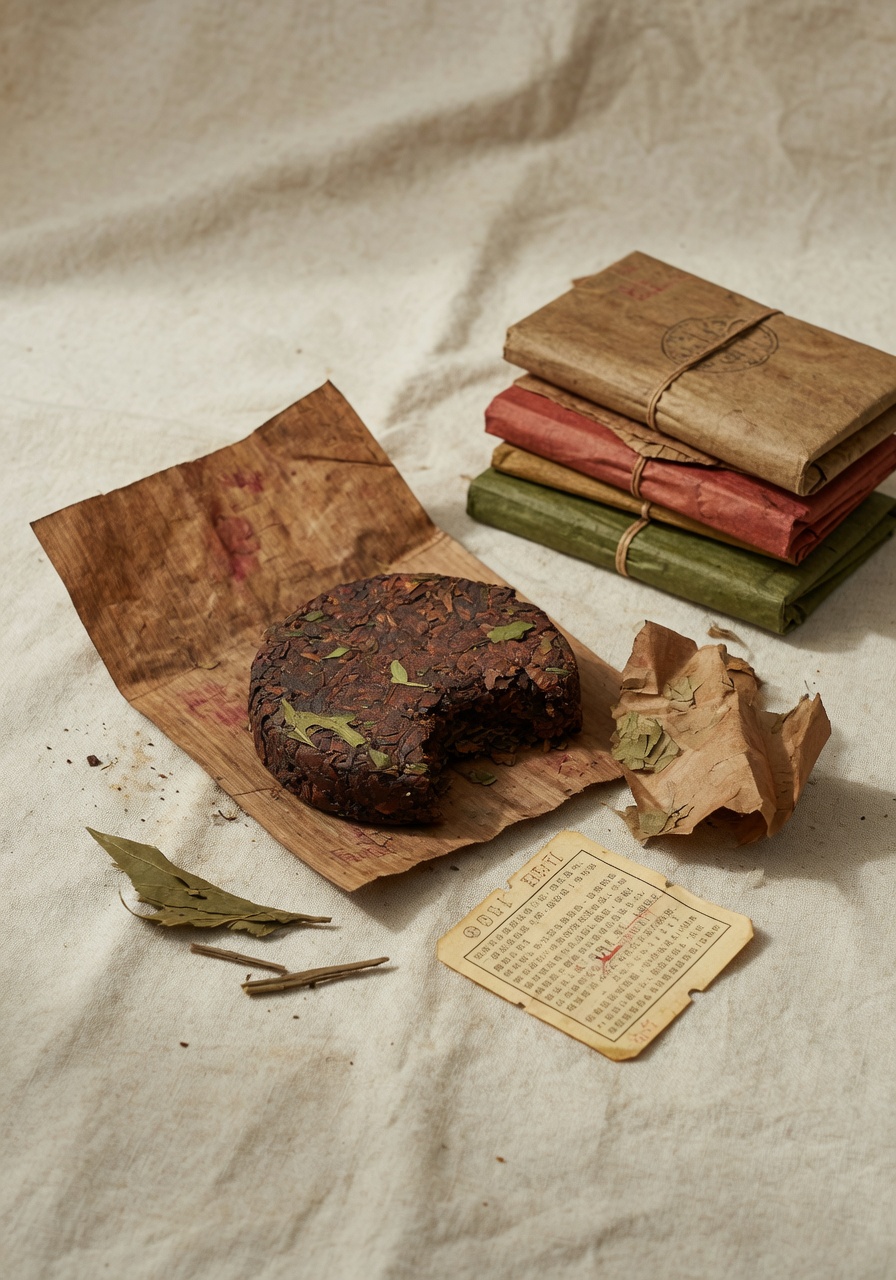
Most of the disappointments I see on the secondary market are not fakes. They are honest cakes described in dishonest language — or, more often, described in language the buyer did not know how to read. When an alert lands in your tea.dog watchlist for a 1999 Shēng Pǔ’ěr (生普洱) from a Yiwu private order, you have roughly three minutes to decide whether to call the seller in Kunming before someone in Kuala Lumpur does. Three minutes is enough, but only if the description has done its work and you have done yours.
I have spent fifteen years moving between Buryatia, Hong Kong, and the border markets around Mengla, looking at cakes that were pressed before I could read Chinese. What I have learned is that the wrapper, the nèi fēi (内飞), the compression face, the edge, and the storage trail each speak a different dialect. A serious seller writes in all five. A careless one writes in two and hopes the photographs cover the rest. The alert system we run here on tea.dog is calibrated against the language used by roughly forty regular sellers across Guangdong, Yunnan, Malaysia, and Taiwan — and the cross-listings we pull from shop.puerh.app and the auction feed on shop.thetea.app. The vocabulary below is what we standardise against.
This thread is not about authentication. Authentication is a separate practice and we cover the nèi piào (内票) versus nèi fēi question in another thread, and the reference plates live on puerh.app. This thread is about condition — the part of the description that tells you, before you spend money on a sample or a flight, whether the cake has lived a coherent life. A 2003 cake with a clean wrapper and a confused storage history is worth less than a 2003 cake with a torn wrapper and a documented twenty-year stay in one Taipei warehouse. Learn to read for coherence and the rest of the work becomes much quieter.
The wrapper — what we mean by foxing, tide line, and worm
The outer paper (wài bāo zhǐ 外包装纸) is the first thing a seller photographs and the first thing we want described in words as well. There are four conditions I want to see addressed explicitly in any listing. Foxing — the rust-brown speckling caused by iron oxidation in damp paper — should be located (upper third, lower edge, around the centre depression) and quantified, not just admitted. A tide line is a darker brown ring where moisture migrated and stopped; one clean tide line tells you the cake was once humid and then dried, which is information. Three overlapping tide lines tells you the storage was unstable, which is a warning. Worm holes — the small punctures from paper-eating beetles common in Guangdong storage — are not in themselves a problem; in fact, a Yiwu cake from Mr Chan’s Sham Shui Po warehouse without a single worm hole is more suspicious to me than one with twelve. What matters is whether the holes go through to the leaf. Finally, ink bleed on the nèi fēi: humid storage softens the printer’s ink, and a slightly haloed character is a storage marker, not a defect. I learned this distinction from a dealer in Ulan-Ude who had handled the same eight cakes for thirty years and could tell you which year each ink halo formed.
Compression face — reading the press without breaking the cake
The face of a 357g bǐng (饼) tells you about pressing pressure, leaf grade, and aging environment all at once. We ask sellers to describe three things. First, tightness: is the cake stone-pressed (looser, with visible interleaf gaps that allow slow oxygen exchange) or hydraulic-pressed (tighter, slower to age, more even)? Stone-pressed Menghai cakes from the late 1990s typically show a slight doming in the centre and the leaves at the edge stand up like the petals of a closed flower — this is what dealers call qǐ máo (起毛), raised nap. Second, edge condition: clean edges with intact tips suggest careful handling; crumbled edges with scattered leaf in the wrapper folds suggest the cake travelled badly or was pressed from too-dry maocha. Third, surface colour gradient: a cake stored in Kunming dry storage will hold a green-brown surface with visible silver tips even at twenty years; a cake from Hong Kong traditional storage will be uniformly dark chocolate-brown with the tips folded down and slightly dulled. Neither is better — they are different dialects of the same word. What you want is consistency between the surface and the back of the cake. If the face is dry-stored and the back shows tide marks, someone has flipped the cake to photograph the better side, and you should ask why. The community on tea.community has a long-running reference thread on press patterns by factory and decade that I send buyers to before any vintage purchase.
Storage trail — the single most expensive line in any description
I will pay thirty percent more for a cake with a clean, single-warehouse storage history than for the same cake with an unknown middle decade. The reason is simple: pu’er does not just age, it acquires a profile, and that profile is built by one climate at a time. A coherent trail reads like this: ‘pressed Menghai 1999, stored Kunming 1999–2008 dry, transferred Guangzhou 2008–2019 natural humidity, currently Foshan climate-controlled 2019–present.’ A confused trail reads: ‘aged storage, good condition.’ The first sentence is a provenance; the second is a hope. When we tag listings on tea.dog with the green checkmark, what we are checking is whether the trail is named, dated, and verifiable through at least one third party — usually an auction record on shop.puerh.app or a transfer photograph. Buryat traders I grew up around had a phrase for cakes without trails: bezdomny chai, homeless tea. Homeless tea drinks fine. It just never reaches what it could have been. If a seller cannot tell you where a cake spent its third decade, assume that decade was difficult.
Aroma descriptors — the words that actually mean something
Sellers love adjectives. Most of them are decorative. The four aroma terms I treat as load-bearing in a vintage shēng description are chén xiāng (陈香), yào xiāng (药香), zhāng xiāng (樟香), and the warning sign cāng wèi (仓味). Chén xiāng is aged aroma — woody, settled, slightly sweet, the baseline you want in anything over fifteen years. Yào xiāng, medicine aroma, develops in cakes that have had a long, stable humid phase and points to deep ginseng-and-bark notes in the cup; it is desirable and rare. Zhāng xiāng, camphor aroma, is associated specifically with old Yiwu and Yibang material aged in Hong Kong tradition and tends to peak between twenty-five and forty years. Cāng wèi is warehouse smell — musty, sharp, slightly sour. A small amount in a cake recently moved out of humid storage will air off in six months; a heavy cāng wèi in a cake that has been in dry storage for a decade means the underlying material is compromised. When a seller writes ‘mild cāng wèi, airing in dry storage since 2022,’ that is honest. When a seller writes nothing about aroma at all, ask. The equipment thread on tea.equipment has a good primer on how to evaluate stored aroma through the wrapper without opening the cake.
The questions to send before you wire money
Once you have read the description against the five dialects above, there will still be gaps. The four questions I send to every seller before committing to a vintage purchase, regardless of price, are these. One: can you photograph the back of the cake in the same light as the front? Two: do you have any record — receipt, photograph, prior listing — of the cake before 2015? Three: has the cake ever been broken into, and if so, can you photograph the interior leaf? Four: what is the cake’s current resting environment in degrees and percent humidity? A serious seller will answer all four within a day. A seller who answers two and deflects two is telling you something. I have walked away from cakes I wanted very badly because the third question was answered with a shrug, and I have never regretted those walks. The cakes find other homes. The point of the alert system, the watchlist, the cross-network search we run here and the related provenance tools on tea.travel for cakes moving across borders — none of it is to help you buy faster. It is to help you buy with fewer surprises. Read the description first. The cake is older than you. It can wait another afternoon.
Open questions for the thread
Which condition descriptor in a vintage listing makes you walk away fastest — and which one have you learned to forgive over time? For those who buy across borders, how do you verify a storage trail when the warehouse owner has retired or the records are informal? And has anyone here built a personal scoring rubric for condition language that they would be willing to share with the watchlist community?