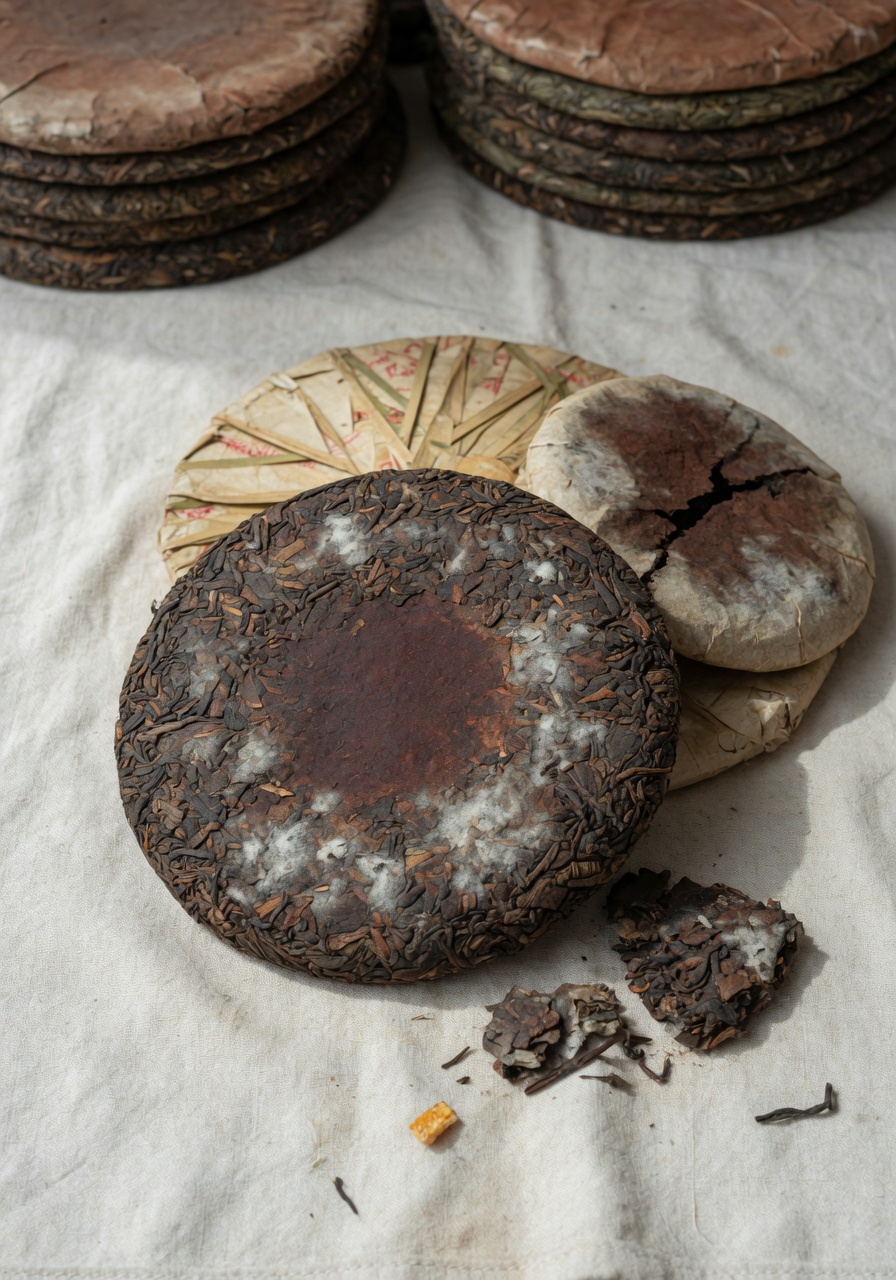
A year of aged cakes, read slowly
Aged-cake watch club is a calendar, not a course. Across fifty-two weeks the membership of thirty-six gathers online once a month to sample a single vintage cake at the same hour, with the same water temperature, in the same gaiwan format. Between those twelve synchronised tastings, four shorter weeks are reserved for context — storage theory, factory history, market read, archive review — so that each cake is met with prepared attention rather than novelty.
The club is led by Amgalan Chin, whose work between Buryatia, Mongolia and the Yunnan border has put him in the path of a particular kind of cake — Russian-route storage, Mongolian dry-warehouse stacks, and the early-2000s production runs that travelled north before the southern market understood what it had. Amgalan curates the calendar a quarter at a time. Cakes are sourced from three streams: his own ageing inventory in Ulan-Ude, vetted private collectors who release a single tong for the club, and selected lots from shop.puerh.app’s auction channel where provenance is documented to factory and wrapper.
The pedagogy is comparative and longitudinal. Each month pairs a focal cake with a reference — usually a younger sibling from the same factory, or the same recipe under different storage. Members brew side by side, on camera, and log impressions into a shared tasting sheet that travels with the cohort for the full year. By month twelve, the sheet itself becomes a document: thirty-six palates reading twenty-four cakes across one season’s arc.
Samples are 10g, vacuum-sealed, posted from the Saint Petersburg fulfilment node two weeks ahead of each session. Members in regions where postage is unreliable can collect at partner tea houses listed on tea.community, or arrange pickup through the tea.travel network when itineraries align. Each sample arrives with a single A5 card — factory, year, wrapper photograph, storage history, recommended leaf-to-water ratio, and the question Amgalan would like the cohort to hold while drinking.
The monthly session runs ninety minutes. The first twenty are spent in silence, brewing in parallel. The next forty are structured discussion led by Amgalan, moving from dry leaf through wet leaf, first infusion, mid-infusions, and spent leaf. The final thirty are open — members raise cakes from their own shelves that the focal tea reminded them of, and the room compares notes. Sessions are recorded and archived on tea.school for members who cannot attend live, though attendance averages thirty-one of thirty-six on any given month.
The twelve focal cakes for the 2026–2027 cycle are weighted toward Shēng Pǔ’ěr (生普洱) from 1998 to 2012, with three Shú Pǔ’ěr (熟普洱) entries to anchor the Wò Duī (渥堆) discussion and one Liu Bao to widen the dark-tea frame. Vintages older than 2005 are sampled at 7g per session split across two brewings; younger cakes at the full 10g. No cake enters the calendar without documented chain of custody — this is the line that separates aged-cake study from aged-cake speculation, and the club holds it firmly.
Context weeks between tastings are lighter in time commitment — a forty-minute recorded lecture and a reading list. Topics rotate through Kunming versus Guangdong storage, the 2007 market correction, wrapper forgery detection, the Menghai recipe family tree, and the practical economics of buying tong versus single cake. Members who complete ten of twelve live sessions receive a signed provenance dossier and standing invitation to the second-year alumni circle, which meets quarterly and travels together to Yunnan every other spring via tea.travel.
The club is deliberately small. Thirty-six seats means every voice fits inside ninety minutes, and every member is known by name to the others by month three. Applications are read rather than counted — Amgalan prefers a mixed table of collectors, vendors, journalists and serious drinkers over a uniform one. Prior pu-erh experience is welcome but not required; what is required is the willingness to sit with the same cake twice and notice what changed.
Week by week
-
Week 1 — Xiàguān Jiǎ Jí Tuó (下关甲级沱) 2003. Opening tasting — calibrating the cohort palate against a known Kunming-stored reference
-
Week 2 — Context — storage theory. Dry, wet and traditional storage — humidity curves and what they do to leaf
-
Week 3 — Xiàguān Jiǎ Jí Tuó (下关甲级沱) 2003 — revisit. Second brewing of session one, solo, with logged notes for the shared sheet
-
Week 4 — Reading week. Wrapper iconography and factory marks — how to read a neifei
-
Week 5 — Dà Yì 7542 (大益七五四二) 2005. The reference recipe — Menghai’s house blend at the twenty-year inflection
-
Week 6 — Context — Menghai recipe family. 7542, 7572, 8582 — how three numbers became an industry vocabulary
-
Week 7 — Dà Yì 7542 (大益七五四二) 2012 — comparative. Same recipe, seven years younger — reading the storage gap side by side
-
Week 8 — Reading week. The 2007 market correction and what it taught long-hold collectors
-
Week 9 — Mèng Kù Róng Shì (勐库戎氏) 2001. Single-factory ageing outside the Menghai orbit — Lincang character at twenty-five
-
Week 10 — Context — Lincang versus Xishuangbanna. Terroir as a slow argument — what survives two decades of cellar time
-
Week 11 — Mèng Kù Róng Shì (勐库戎氏) 2001 — second pour. Returning to the leaf — late infusions and the question of bottom notes
-
Week 12 — Reading week. Buying tong versus single cake — the practical economics of long holds
-
Week 13 — Zhōng Chá Hóng Yìn (中茶红印) replica 1999. Studio replica of the Hong Yin recipe — what a careful copy can and cannot teach
-
Week 14 — Context — Zhongcha era production. State factory output 1996–2003 and how to authenticate it
-
Week 15 — Zhōng Chá Hóng Yìn (中茶红印) replica 1999 — revisit. Logging the second encounter — what the palate now finds that it missed
-
Week 16 — Reading week. Wrapper forgery detection — paper, ink, fold, and the obvious mistakes
-
Week 17 — Lǎo Bān Zhāng (老班章) gushu 2008. Old-tree single-village shēng at fifteen — bitterness as architecture
-
Week 18 — Context — gushu definitions. Tree age, garden boundary, and what ‘gushu’ has come to mean in 2026
-
Week 19 — Lǎo Bān Zhāng (老班章) gushu 2008 — comparative. Paired against a 2018 sibling cake from the same village
-
Week 20 — Reading week. Provenance dossiers — what documentation actually protects
-
Week 21 — Yì Wǔ Zhèng Shān (易武正山) 2004. Yiwu softness at twenty — the southern argument for slow ageing
-
Week 22 — Context — Yiwu villages. Mahei, Gaoshan, Luoshuidong — reading the micro-region inside the name
-
Week 23 — Yì Wǔ Zhèng Shān (易武正山) 2004 — second pour. Aroma persistence and the long Yiwu finish
-
Week 24 — Reading week. Shou theory before the Wò Duī tasting — what fermentation actually is
-
Week 25 — Dà Yì 7572 (大益七五七二) 2006. First shou of the cycle — the recipe that defined the category
-
Week 26 — Context — Wò Duī (渥堆) process. Pile fermentation at Menghai — temperature, turning, and the forty-five-day window
-
Week 27 — Dà Yì 7572 (大益七五七二) 2006 — revisit. Mid-aged shou — the point where the wet-pile note leaves the cup
-
Week 28 — Reading week. Kunming versus Guangdong storage — the great dividing question
-
Week 29 — Lǎo Tóng Zhì (老同志) 9978 2007. Haiwan factory’s restrained shou — leaner pile, longer rest
-
Week 30 — Context — secondary factory landscape. Haiwan, Lao Man’e, Liming — the producers behind the headline names
-
Week 31 — Lǎo Tóng Zhì (老同志) 9978 2007 — comparative. Paired against the 7572 from week 25 — two shou philosophies
-
Week 32 — Reading week. Pricing the aged cake — auction reads via shop.puerh.app
-
Week 33 — Liù Bǎo (六堡) 1998 basket. Widening the frame — Guangxi dark tea at twenty-eight years
-
Week 34 — Context — dark tea family. Liu Bao, Anhua, Fu brick — the broader Chinese aged-tea constellation
-
Week 35 — Liù Bǎo (六堡) 1998 basket — revisit. Returning to Liu Bao with shou comparison fresh in memory
-
Week 36 — Reading week. Russian-route storage — Buryatia, Mongolia, and the northern cellar tradition
-
Week 37 — Xiàguān Tiě Bǐng (下关铁饼) 2002. Iron-pressed cake — how compression shapes the twenty-year arc
-
Week 38 — Context — pressing methods. Stone mould versus iron — physical density and rate of ageing
-
Week 39 — Xiàguān Tiě Bǐng (下关铁饼) 2002 — second pour. Core versus edge of the cake — sampling the gradient
-
Week 40 — Reading week. Building a personal cellar — humidity, airflow, and the first hundred cakes
-
Week 41 — Bā Nà Hào (巴纳号) Yiwu 1999. Private-label cake from the early revival era — small batch, documented
-
Week 42 — Context — private brands 1996–2004. The boutique producers who rebuilt Yiwu after the state-factory era
-
Week 43 — Bā Nà Hào (巴纳号) Yiwu 1999 — comparative. Paired against the 2004 Yiwu from week 21 — five years of difference
-
Week 44 — Reading week. What the cohort tasting sheet now shows — twelve months of read patterns
-
Week 45 — Lán Yìn Tiě Bǐng (蓝印铁饼) replica 2001. The blue-mark recipe at twenty-five — heritage cake, modern provenance
-
Week 46 — Context — heritage replicas. When is a replica honest — the ethics of historical recipe work
-
Week 47 — Lán Yìn Tiě Bǐng (蓝印铁饼) replica 2001 — revisit. Second sitting — what authority the replica earns over time
-
Week 48 — Reading week. The next year — second-year alumni circle and the Yunnan field trip via tea.travel
-
Week 49 — Member-curated cake — selected by cohort vote. The thirteenth cake — chosen by the membership from three Amgalan finalists
-
Week 50 — Context — closing the loop. Reviewing the year’s tasting sheet — patterns, surprises, and held questions
-
Week 51 — Member-curated cake — second pour. Final synchronised tasting of the cycle
-
Week 52 — Closing session. Provenance dossiers issued — open conversation with Amgalan on next steps
What’s included
-
Twelve 10g samples of vintage cakes posted from Saint Petersburg, vacuum-sealed with provenance card
-
Twelve ninety-minute synchronised online tastings led by Amgalan Chin
-
Forty short context weeks with recorded lectures, reading lists and discussion threads
-
Access to the shared cohort tasting sheet — thirty-six palates across twenty-four cakes
-
Full session archive hosted on tea.school for members unable to attend live
-
Auction-channel briefings via shop.puerh.app with documented chain of custody
-
Signed provenance dossier on completion of ten of twelve live sessions
-
Standing invitation to the second-year alumni circle and Yunnan field trip via tea.travel
-
Listing on the tea.community member directory for ongoing peer exchange